
Order book. Part 1.
I had a desire to write a highload project in C++ with some application in high-frequency trading, finance, and related fields. My goal is not exactly to dive into the domain of a problem, but rather to carry out millions of operations per second and make a solid C++ project (with tests, scripts, and benchmarks).
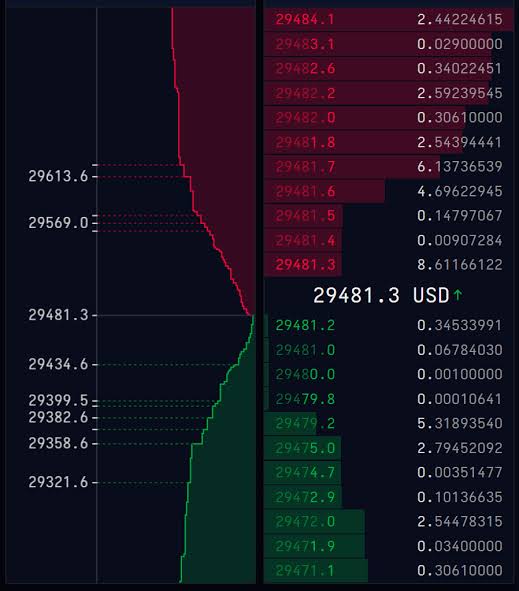
I came to the idea of writing an order book - a structure that keeps track of all the buy and sell orders (bids and asks, respectively). It can be found on stock exchanges’ UIs. For example, buy orders on the left (marked green) and sell orders on the right (marked red).
An image of an order book I found on the Internet:
I began thinking about the implementation part of the order book. The first assumption I’ve made is that prices are not floating-point numbers, they are just integers. This way I can avoid problems with math and special handling of numbers:
using Price = unsigned int;
How am I going to store bids and asks efficiently, so that it doesn’t consume much memory, doesn’t degrade performance, and still provides a solution to the problem? I came to the idea of using an array, where each index of this array is a price.
A couple of advantages of having an array here:
1) As I understand it, most operations are done at the intersection of buy and sell prices. In an array, these cells are going to be near each other. Such a placement in memory is cache-friendly.
2) O(1) access complexity.
Even though the array seems good here in a performance sense, what about memory? Will it be reallocated every time a new, higher price arrives? I thought it would be a problem, so I made a second assumption here - the price is going to be limited at the top by some value. I think it’s a huge oversimplification on my part, but again, I’m not trying to make a real-world-like order book that can be used in real projects, at least for now. Maybe in the future I’m going to implement this part “correctly”.
constexpr std::size_t MAX_PRICE_VALUE = 9999U, MIN_PRICE_VALUE = 1U;
So, the array is going to be preallocated and stay the same size during the whole execution of the program. But what does this array store exactly? How should I store the orders with the same price?
The only operations I’ll be doing with the orders at a specific price are adding and removing. And the order of insertion and removal is important, because if I have a bunch of bids and an ask comes in, then the oldest bid has to be processed first. Also, I don’t need to access a random order at a price; it’s just not required for the problem I’m trying to solve.
I think a logical solution for this is a queue of orders. If a new order arrives, then it’s either inserted at the end of the queue, or processed from the start (the oldest ones). I have doubts about such a choice though: the queue is not cache-friendly like an array, so I guess it can affect performance negatively.
  /**
  * @brief Array of prices that holds bids and asks.
  *
  */
  std::array<std::queue<Order>, MAX_PRICE_VALUE + 1> prices;
It’s also a vital part to take care of executing orders if they match - when a bid and an ask have the same price. For such cases I added a bids start index and an asks start index. Basically, these variables are the prices of the highest bid and the lowest ask. I was thinking about using iterators instead of plain numbers, but in my case I need the exact price of the top-most bid and the bottom-most ask. Iterators just don’t fit well for handling the intersection of bid and ask prices.
  /**
   * @brief Take care of top bids price and bottom asks price.
   *
   */
  Price bidsStart{MIN_PRICE_VALUE}, asksStart{MAX_PRICE_VALUE};
About the interface that the order book has to provide. At first, I thought of just two functions:
1) apply the order.
2) print out the whole order book.
During the process of implementing these functions, I added two more: getting the total number of present orders and getting the orders at a specific price. I don’t think they are going to be used in the project as I see it, but nonetheless, I added them for testing and possible future extensions.
Here is what class OrderBook looks like:
class OrderBook {
 public:
  std::expected<void, OrderBookError> applyOrder(const InputOrder&);

  std::size_t getTotalOrdersCount() const;
  std::expected<std::vector<Order>, OrderBookError> getOrdersAtPrice(
      Price) const;

  void dump(std::ostream& os) const;

 private:
  void addOrderAtPrice(const Order&, Price);

  void executeBid(const Order&, Price);
  void executeAsk(const Order&, Price);

  void advanceAsksBoundary();
  void retreatBidsBoundary();

 private:
  /**
  * @brief Array of prices that holds bids and asks.
  *
  */
  std::array<std::queue<Order>, MAX_PRICE_VALUE + 1> prices;

  /**
   * @brief Take care of top bids price and bottom asks price.
   *
   */
  Price bidsStart{MIN_PRICE_VALUE}, asksStart{MAX_PRICE_VALUE};
};
I’ll get to the implementations in the next part of this series.